Lagrange Points in Orbital Mechanics
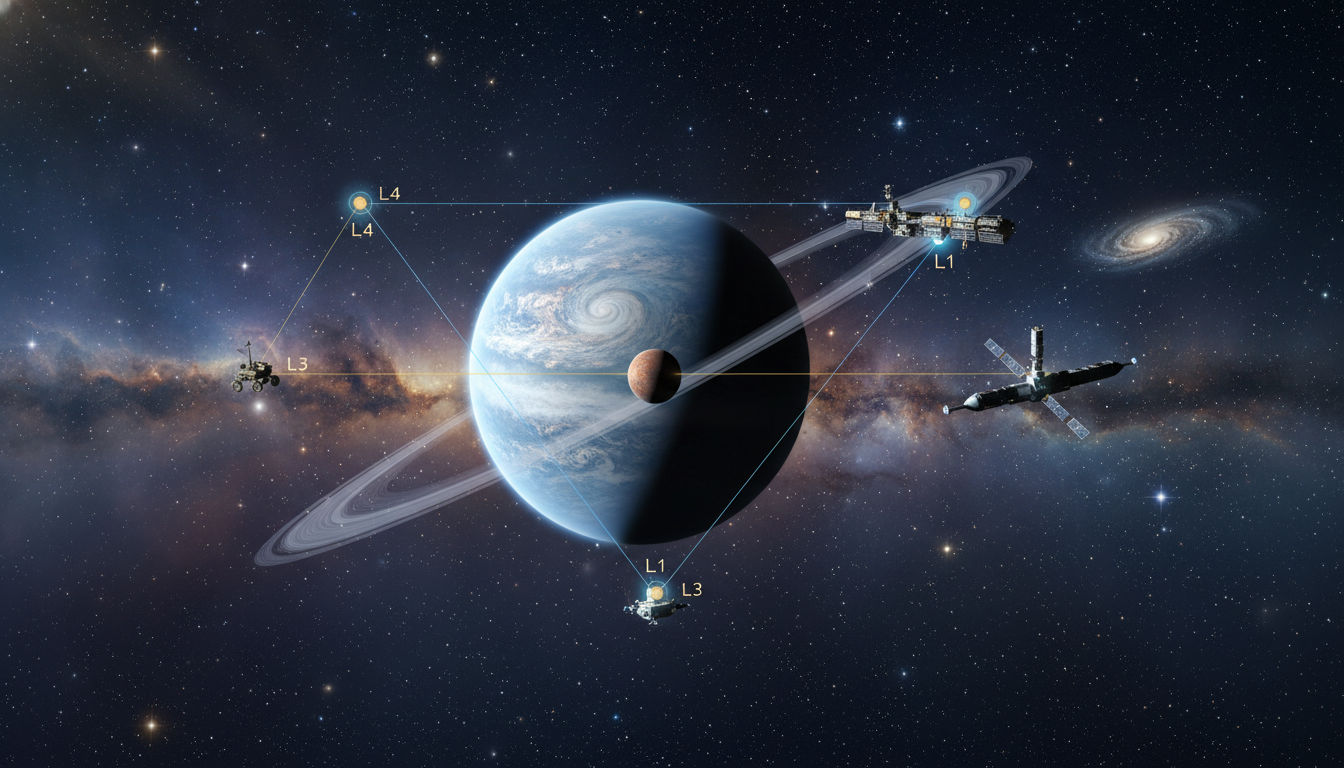
Lagrange points are specific positions in space where gravitational forces and the orbital motion of two large bodies create a stable environment for smaller objects, making them crucial for satellite
Have you ever wondered how satellites can maintain their positions in space without constantly using fuel?
This fascinating phenomenon is made possible by what are known as Lagrange points.
Named after the French mathematician Joseph-Louis Lagrange, these unique spots occur in the gravitational influence of two large celestial bodies, like the Earth and the Moon or the Sun and the Earth.
Imagine a place in space where the forces of gravity and the motion of the two bodies balance perfectly.
At these points, a smaller object, such as a satellite, can remain stable with minimal energy expenditure.
There are five such points, labeled L1 through L5, each with its own unique characteristics.
For instance, L1 sits directly between two massive bodies, allowing a satellite to maintain a constant view of one of them, which is ideal for solar observation.
Meanwhile, L2 is located on the opposite side of the smaller body, providing an unobstructed view of deep space.
These points are not just theoretical; they have practical applications.
Many satellites, including those used for weather monitoring or astronomical observations, are strategically placed at these points to maximize their effectiveness and longevity.
But why do these points matter for future space exploration?
As we advance our technology and look toward missions beyond our planet, understanding Lagrange points could help us establish bases or observatories in a stable environment.
What other mysteries of space might we uncover by exploring these gravitational havens?
Stay tuned as we delve deeper into the implications of Lagrange points in the future of space travel.